
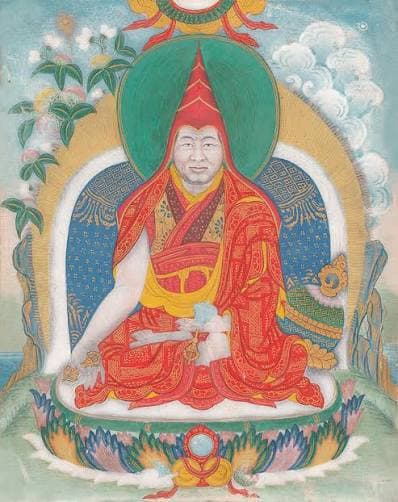
Khenpo Ngakchung
KHENPO NGAWANG PALZANG
One of the most important Dzogchen exegetes of the Nyingma school in the twentieth century. At Kathok Monastery he propagated the Longchen Nyingtik, composed a vast body of writings, and took part in recognizing the Third Penor Rinpoche. He is revered as an emanation of Vimalamitra and Longchenpa.
The Manifestation of an Emanation
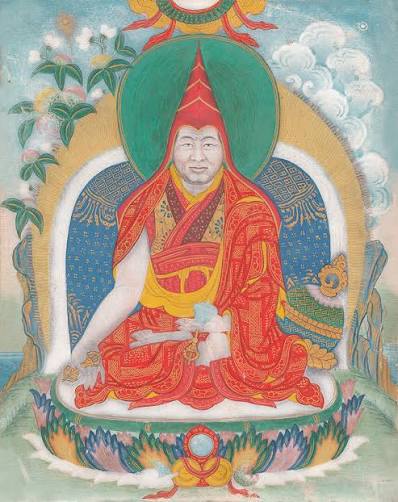
The master's name was Ngawang Palzang, also called Ösal Rinchen Nyingpo, with the secret name Dorje Sijey Tsal, and he is widely known as Khenpo Ngakchung. On the tenth day of the tenth month of the Earth-Hare year of the Tibetan calendar, he was born into the Nyoshul family in the southern reaches of Derge in Kham, near the sacred mountain of Kathok. His father was named Namgyal and his mother Pema Tso. From his earliest years the master displayed marvelous signs and an unmistakably keen capacity for awakening. Long ago, when the great Indian paṇḍita Vimalamitra departed from Tibet, he made a prophecy that once every hundred years he would send forth an emanation to remain in the world and to uphold the life-line of the Dzogchen heart-essence; and the omniscient Longchenpa likewise appeared in this world as a manifestation of Vimalamitra's wisdom. Later masters one and all came to regard this master as the emanation in whom these two saints, Vimalamitra and Longchenpa, were united as one—a great spiritual friend who arose in answer to the needs of the Dzogchen teachings in the modern age.
Reliance on the Root
At the age of seven the master learned reading and writing from his uncle, and from the age of eight he gradually received empowerments and teachings, taking the novice vows at fifteen, in the Water-Snake year. His root teacher was the master Nyoshul Lungtok Tenpe Nyima—the personally instructed heart-son of Patrul Rinpoche and the direct heir to the oral-lineage pith instructions of the Longchen Nyingtik. The master relied upon his teacher for many years and received in full the oral-lineage instructions of the Longchen Nyingtik—the preliminaries, the main practice, and the Dzogchen practices of trekchö (cutting through) and tögal (direct leap). Lungtok Rinpoche had once received from Patrul Rinpoche, on the slope behind Dzogchen Monastery while gazing up at the night sky, the pointing-out instruction—"Do you see the stars in the sky? The nature of Dzogchen is just like this"—and thereby gained decisive realization of the luminous nature of awareness; this teaching on the primordial nature, handed down through an unbroken line, was thus received complete by the master. His teacher also personally confirmed him to be an emanation of the great omniscient one. Thereafter the master also undertook extensive study and reflection under such masters as the tertön Sogyal, the treasure-revealer Ngawang Tendzin, Khenpo Shenga, Khenpo Künpang, and Kathok Situ Chökyi Gyatso, and at the age of twenty he received the full vows of a fully ordained monk. His discipline was pure and his learning profound.
Spreading the Teachings at Kathok
After completing his studies, the master took up residence at the sacred place of Kathok. He first served as khenpo at the "Mount Meru" tantric study and practice college at Kathok for about thirteen years, expounding the scriptures and conferring vows in an unbroken stream of instruction; later he founded a college for the study and practice of both sutra and tantra, widely propagating the teachings of the sutras and tantras and training more than thirty wise disciples. At that time the tradition of expounding the scriptural teachings of Dzogchen had for a time grown faint, but through the depth and breadth of his realization and his eloquence, the master revived the practice of teaching and debating the Dzogchen sutras and tantras, and he was acclaimed as the greatest exegete, teacher, and inheritor of the Longchen Nyingtik of his age. Here he propagated the preliminary and main practices of the Longchen Nyingtik, transmitted the generation and completion stages and the pith instructions of trekchö and tögal, and from among his disciples khenpos and tulkus arose in succession—so that later generations spoke of his "Four Heart-Sons," "Eight Great Pillars," and "Thirteen Beads of the Rosary," and his teachings spread far across Kham and Tibet.
A Vast Body of Writings
What later generations most prized in the master was that he set down in writing, one by one, the oral-lineage pith instructions of the Longchen Nyingtik that had been handed down by word of mouth from Patrul Rinpoche onward through the single lineage of Nyoshul Lungtok Tenpe Nyima, so that the essential Dzogchen instructions—originally a secret, heart-to-heart transmission—might be passed on in writing and benefit those yet to come. His autobiography, The Magical Dance of Illusion, sets out in full the teachings on the generation, completion, and Dzogchen stages, and serves as a touchstone for those who train in the heart-essence. The master also composed extensive notes on Longchen Nyingtik practices such as the Vidyādhara Assembly and the Great Compassionate One Assembly, and wrote works of explanatory guidance on root texts such as The Words of My Perfect Teacher; in addition, he composed many works of admonition, supplication, songs of realization, confession liturgies, and sādhanas. His collected works comprise about nine volumes, many of them oral-lineage pith instructions, some transmitted secretly under a seal of confidentiality, and they remain to this day in the process of being compiled and published.
Recognizing Penor
The master held an indelible dharmic connection to the continuation of the Palyul lineage. In the Water-Monkey year, after the passing of the Second Penor Rinpoche, the master dispatched a search party that recognized the child born into the family of Pema Norbu as the reincarnation, and together with the Fifth Dzogchen Rinpoche and others he confirmed the recognition. In the Fire-Mouse year, the master invited the young tulku to Palyul Monastery, personally cut his hair, bestowed upon him the name Dongak Shedrup Tendzin, conferred a long-life empowerment, and personally composed a long-life supplication, laying the deep dharmic foundation for his life of upholding and spreading the teachings. This tulku was none other than the Third Penor Rinpoche, who would go on to uphold the banner of the Nyingma teachings and liberate beings far and wide. From among the master's disciples there also arose modern masters such as Shatral Rinpoche and Drubwang Pachen Dewa; ascending to the lineage of Guru Padmasambhava, Vimalamitra, Longchenpa, Jigme Lingpa, Patrul Rinpoche, and Nyoshul Lungtok, and descending to inaugurate the various transmissions of Palyul and the Nyingma, his merit in carrying forward what came before and opening the way for what followed is beyond conception.
Signs of Passing into Nirvana
On the seventeenth day of the fifth month of the Iron-Snake year of the Tibetan calendar, the master displayed his passing into nirvana at Kathok, at the age of sixty-three. After his cremation, indestructible five-colored vajra relics appeared among his bones, corresponding to the signs of accomplishment recorded in the Dzogchen tantras—ample proof of the ultimate fruition of his lifelong practice and realization. As the emanation in whom Vimalamitra and Longchenpa were united as one, the master revived the exposition of the Dzogchen scriptural teachings, set down the oral-lineage pith instructions in writing for the benefit of later students, and recognized and nurtured the Third Penor Rinpoche; his nine volumes of writings and his single autobiography thus became a core treasury of the dharma for later generations who train in the Longchen Nyingtik. Though his form-body is hidden, the luminosity of his heart-essence teachings endures undiminished through time, illuminating to this day the lineage of the old translations of the Nyingma.