
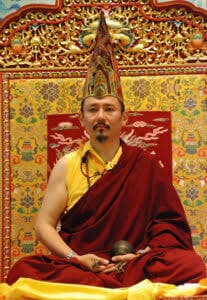
Palyul Choktrul Rinpoche
PALYUL CHOKTRUL RINPOCHE
The Choktrul (emanation) Rinpoche of the Palyul tradition, root guru of the Third Penor Rinpoche. He presided over the enthronement of the Dharma King and transmitted to him the entire body of Palyul teachings together with the pith instructions of the Great Perfection.
Recognition as an Emanation
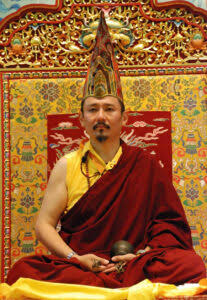
The master's given name was Jampa Gyalwé Dorje, with the dharma name Tupten Jikmé Chökyi Dawa; he was also known as Tartang Choktrul and Dzongnang Lama. He was born in the Wood Horse year of the fifteenth sexagenary cycle of the Tibetan calendar (1894) at Gyalka Buto in Gyarong, Amdo, into the Kunzang Sherab family. In childhood he was recognized as the reincarnation of the previous Choktrul Rinpoche — Dzongnang Lama Jamyang Sherab Chökyi Nangwa — and was likewise regarded as an emanation of Gyatrul Pema Döngak Tendzin. He was escorted to Tartang Monastery and enthroned. The master was one of the most important vidyādhara forefathers of the Palyul tradition of the Nyingma (Old Translation) school. His succession of titles is intricate, embodying the lineages of both "Palyul Choktrul" and "Dzongnang Lama," and from his youth he bore the responsibility of continuing the Palyul dharma lineage.
Studying Widely Under Many Masters
The master relied upon Lachu Rinpoche as his root guru and received from him the complete heart-essence transmission. He then sought out the great spiritual teachers of his age far and wide: at the feet of the Apang tertön Pawo Chöying Dorje, of Katok Situ Chökyi Gyatso, and of the Palyul Drubwang Rigdzin Penchen Düpa, he received the Great Perfection, the Great Seal (Mahāmudrā), and all the treasure teachings of Palyul. From masters such as Khenpo Ngawang Palzang (Khenpo Yönga) he made a deep study of the sūtra and tantra scriptures and treatises, together with the essential pith instructions of the Longchen Nyingtik. In the actual practice of the generation and completion stages, of cutting through (trekchö) and direct crossing (tögal), he received the personal transmission of the successive lineage gurus and attained unobstructed mastery, uniting in himself the empowerments, oral transmissions, and pith instructions of the Palyul tradition — truly a dharma vessel of his generation.
Upholding the Precepts and Reviving Monasteries
The master was renowned for his strict observance of the prātimokṣa vows. His bearing was majestic and dignified, his demeanor as still and steady as a sculpted image, and his conduct everywhere accorded with the discipline — a model of the Palyul tradition's vinaya conduct, revered by monastics and laypeople alike. In his middle years, the master oversaw the rebuilding of the retreat center at Tartang Monastery, erected new temple halls, and reformed the regulations of the practice grounds. He also traveled throughout Gyarong and the surrounding regions, widely transmitting the Great Perfection and the Palyul teachings, protecting and restoring numerous monasteries, so that the banner of the Dharma was raised anew and the saṅgha dwelt in peace. Throughout his life, his every act was guided by purity in upholding the precepts and the wish to magnify the Three Jewels.
Transmitting the Lineage in Full
The most important activity of the master's life was the cultivation of the Third Penor Rinpoche. From roughly the 1930s to the 1940s, the master lived together with the young Penor Rinpoche (Lekshe Chökyi Drayang) in a retreat chamber at Tartang Monastery, practicing together for nearly four years; they were inseparable day and night as he taught him without reserve. The master conferred ordination upon the Dharma King and transmitted to him, one by one, nearly all of the principal empowerments, oral transmissions, and Great Perfection pith instructions of the Palyul tradition — the outer prātimokṣa vows, the inner bodhisattva vows, the secret-mantra samaya, and the empowerments of many great dharmas. The master once vowed: if he could not transmit to Penor Rinpoche the whole of the Great Perfection's empowerments and pith instructions, his life would be as good as wasted. It was precisely this deep transmission between master and disciple that laid the foundation for Penor Rinpoche's later role as the eleventh-generation throne-holder of the Palyul tradition and supreme dharma sovereign of the Nyingma school. Among his other disciples were Tartang Tulku Künga Gelek Yeshe Dorje, Dzongnang Jampa Lodrö, Khangsar Tenpé Wangchuk, and Tupten Tsöndrü, each of whom carried forth the essence of the teachings and spread it in his own region.
His Writings — Survived and Lost
The master was of profound learning. He once composed a commentary on the Palyul "Mountain Dharma" (the intensive retreat practice), some four hundred pages in length, as well as commentarial works related to Tsongkhapa's Golden Garland of Eloquence. Sadly, these two great works were both scattered and lost amid the turmoil of the times, and most no longer survive today. Fortunately, scattered dharma sayings have been handed down, such as the Counsel to Orgyen Rigdzin and a four-line Brief Aspiration Prayer for Transference to the Pure Land of Great Bliss, every word of which flowed from his realization and which are still recited by later students. His extant works were gathered into a single volume and published in 2008, allowing the milk of the master's Dharma to be continued.
Passing Beyond and the Signs He Left
During the dharma persecution in Tibet in the 1950s, the master fell victim to the political upheaval and was arrested and held in the Saidruk-chen labor camp. Even imprisoned, his resolve to uphold the precepts and the lineage remained unwavering unto death. On the twenty-fifth day of the ninth month of the Earth Dog year of the Tibetan calendar (1958), the master passed away serenely in prison, accompanied by many auspicious signs, which later generations regard as marks of accomplishment in the Great Perfection. His reincarnation — the Third Palyul Choktrul, Jikmé Chökyi Senge — was born in India in 1966, and was sought out and recognized when the Third Penor Rinpoche invited Dudjom Rinpoche and the Sixteenth Karmapa to enter meditative absorption together. The dharma bond of master and disciple continues life after life, and the lamp of the lineage burns on, unbroken as a slender thread.