
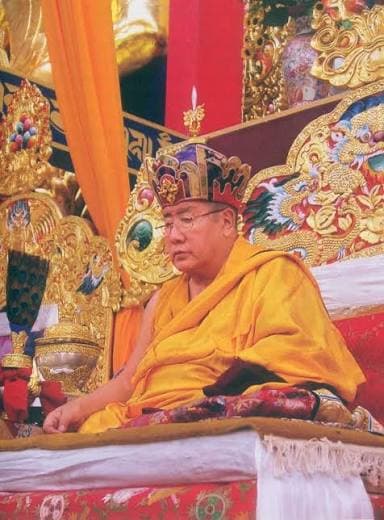
Penor Rinpoche III
PENOR RINPOCHE III
Thubten Lekshe Chökyi Drayang Pal Zangpo — the root guru of Khenpo Nima Rinpoche, and a great master of the modern revival of the Palyul lineage.
An Emanation Appears in the World
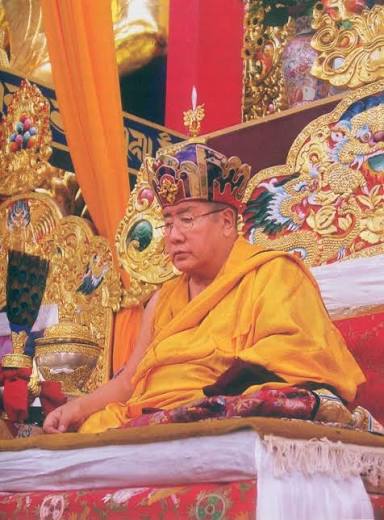
His Holiness the Third Drubwang Pema Norbu Rinpoche was born in the winter month of the Water Monkey year (1932) in the region of Powo, in the Kham district of eastern Tibet. His father was named Sonam Gyurme and his mother Tsongkyi. His biography records that at the time of his birth, amid the severe cold of deep winter, fragrant flowers suddenly bloomed all around the house — a sign that everyone regarded as an auspicious mark of a great being returning by the power of his vow. He is universally acknowledged as an emanation of Vimalamitra — the eighth-century Dzogchen patriarch and one of the three figures known as Khen-Lob-Chö — and is also held to be a manifestation of the bodhisattva Vajrapani. Around 1936, search parties dispatched by the Fifth Dzogchen Rinpoche and by the Palyul Khenchen Ngawang Palzang arrived at the door of his home on the very same day and at the very same hour; comparing what each had perceived, they jointly recognized him as the reincarnation of the Second Penor Drubwang Pema Norbu Tegchok Tenpai Gyaltsen, and at his ordination he was given the name "Thubten Lekshe Tenzin Chöle Namgyal."
Enthronement and Succession
Around 1937, he was invited to the ancestral seat of Palyul in Kham and enthroned, succeeding to the dharma throne and becoming the eleventh throne-holder of the Palyul lineage. Marvels appeared repeatedly in his youth: once he repaired a broken vajra with his saliva, and the vajra became sturdier than before; a golden bell that fell upon a boulder did not shatter, and its tone instead rang the more clear; at the age of fifteen, at the Dago retreat place, he pressed his foot upon stone to leave a mark, and the footprint sank into the rock — it is said to remain there to this day. He relied upon his root guru, Khenchen Ngawang Palzang (Khenpo Ngakchung), and further received teachings from his enthronement guru Thubten Chökyi Dawa, his mind-transmission guru Lungtok Rinpoche Lekshe Tenpa Nyima, the Fourth Karma Kuchen Karma Trinley Nyingpo, and other great spiritual masters. At the age of twenty-one, he received full monastic ordination at the ancestral seat of Palyul within the Vinaya transmission introduced by the master Shantarakshita. Thereafter he entered a four-year long-term retreat, fully receiving all the empowerments, oral transmissions, and the pith instructions of the Dzogchen generation and completion stages, of trekchö and tögal, of the Palyul lineage, becoming a Vajradhara endowed with the three vows and perfect in scripture and realization.
Exile and Revival
In 1959, as the situation in eastern Tibet abruptly changed, he could not bear to see the Nyingma teachings fade away like a rainbow. He therefore led more than three hundred followers across the snow ranges, taking the route through Pemakö, and journeyed south to India through great hardship. Along the way, treacherous terrain and pestilence pressed upon them together, and the losses were grievous; in the end only about thirty of those who set out survived. He vowed to revive the genuine dharma through the three wheels of teaching, practice, and enlightened activity. In 1961, the company reached the refugee resettlement areas of Mysore and Bylakuppe in South India and settled there. In 1963, with a mere five hundred rupees and eight monks, he erected a bamboo shelter as a temple in the resettlement land, laying the foundation of Namdroling Monastery (Thegchog Namdrol Shedrub Dargye Ling). Through several decades of unyielding and tireless labor, Namdroling today numbers more than three thousand monks, its temple halls towering high, and has become the largest Nyingma monastery and a great center of Buddhist learning of the present age — by which the Palyul lineage could renew its living wisdom outside the Land of Snows.
The Work of Spreading the Dharma
Throughout his life he held the upholding of the lineage and the wide transmission of empowerments and oral instructions to be his foremost task. In particular, he transmitted on a vast scale the Namchö (Sky Treasure) terma cycle that lies at the heart of the Palyul tradition, as well as profound and far-reaching teachings such as the Lama Gongdü (Embodiment of the Guru's Realization), causing the pith instructions of the heart-essence to continue unbroken. In 1978, he established the Ngagyur Nyingma Higher Institute of Buddhist Studies at Namdroling, broadly nurturing monastic talent; over the decades it has trained several hundred khenpos who have spread far and wide across the world. From his first journey to America to teach the dharma in 1985 onward, he traveled for many years throughout North America, turning the great wheel of dharma, bestowing empowerments widely, and establishing Palyul dharma centers and retreat centers at home and abroad, gathering in countless sentient beings. He distinguished himself not through written composition but through bestowing teachings, oral transmission, and retreat guidance — continuing the wisdom-life of the Buddha and carrying the Palyul lineage far across the world.
Supreme Head of the Lineage
In 1993, at the Nyingma Mönlam great prayer assembly in Bodh Gaya, India, representatives of the Nyingma school from across the world unanimously elevated him to become, after Dudjom Rinpoche and Dilgo Khyentse Rinpoche, the Third Supreme Head of the Nyingma School, and he was formally confirmed in this office by the Fourteenth Dalai Lama at Dharamsala. He held the teaching seat for about ten years, retiring with his work accomplished in 2001, succeeded by Mindrolling Trichen Rinpoche. From among his disciples great masters arose in abundance: the Fifth Karma Kuchen Rinpoche succeeded to the dharma seat of Namdroling, while Khenchen Namdrol Rinpoche, Khenchen Tsewang Gyatso Rinpoche, and others became pillars of the Institute of Buddhist Studies. Khenpo Nima Rinpoche, upon whom this dharma center relies, was likewise confirmed by him as a qualified khenpo rinpoche — and from this very transmission flows the lineage of the Longchen Buddhist Centre of Hong Kong.
The Signs of His Passing
On the evening of March 27, 2009, he sat upright in correct posture at Namdroling Monastery and entered the profound meditative absorption of tukdam. His body did not slump, his complexion remained as in life, and he rested in the very nature of luminous awareness for about seven days, only emerging from absorption and displaying parinirvana on April 3, at the age of seventy-seven. Such a passing — entering great absorption and only afterward displaying nirvana — was regarded by all his disciples as a manifest token of the realization of a great accomplished master. At the end of 2011, his reincarnation, Mingyur Dechen Ngawang Shenong Dorje, was born into the world; in 2014 he was enthroned at the ancestral seat of Palyul in Kham, succeeding to the twelfth dharma throne of Palyul — the torch of the lineage passing on, unbroken and continuous.