
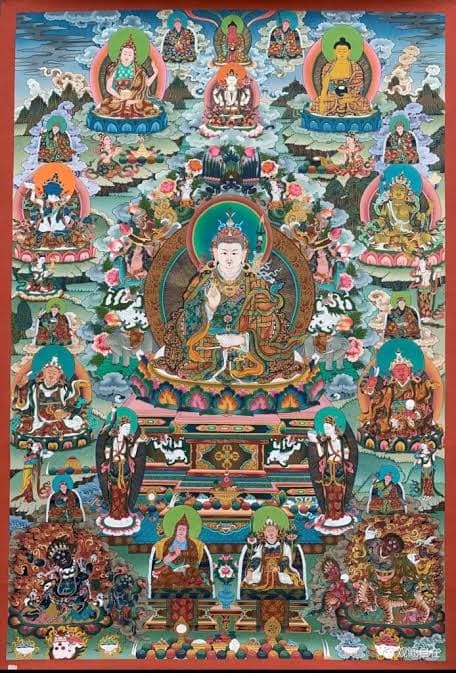
Guru Padmasambhava
GURU PADMASAMBHAVA
Root forefather of the Old-Translation Nyingma school, revered in Tibet as "Guru Rinpoche" (Precious Master). The two heart-essence systems propagated at this centre both arise from the Great Master's compassionate skilful means.
ཨོཾ་ཨཱཿཧཱུྃ་བཛྲ་གུ་རུ་པདྨ་སིདྡྷི་ཧཱུྃ
Born from a Lotus
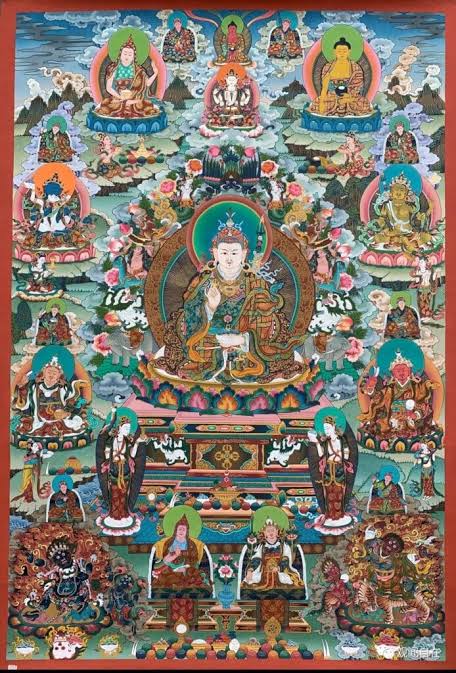
Padmasambhava, the Lotus-Born, is revered in Tibet as "Guru Rinpoche" (Precious Master) and is also called the "Second Buddha of Oḍḍiyāna." He is the root forefather of the Old-Translation Nyingma school. Before entering parinirvāṇa, Buddha Śākyamuni prophesied that there would come a Vajra-Holder greater than himself, who through the way of the unsurpassed secret mantra would liberate beings far and wide. So it was that — as the very compassionate aspiration of Buddha Amitābha and the emanation of Avalokiteśvara — he took miraculous birth upon a lotus blossom in the midst of Lake Dhanakośa in the land of Oḍḍiyāna, appearing in the form of an eight-year-old child, born without father or mother, blazing with brilliant light. At that time King Indrabhūti of Oḍḍiyāna, who had no heir, came following the lake and beheld the holy child seated upon the lotus; rejoicing, he welcomed him home and installed him as crown prince, naming him "Lotus King" (Pema Gyalpo). Because the Great Master manifested in the human world in the manner of an emanation-buddha, he is called "Lotus-Born" (Padmasambhava), signifying the primordial nature that is pure and unstained, transcending birth and death. Later, for the sake of the work of spreading the Dharma and liberating beings, the Great Master renounced the throne and entered the eight great charnel grounds to cultivate the secret Dharma in earnest; among the cold-forest charnel grounds he subdued inner and outer demonic obstacles and perfected the foundation of a vidyādhara (awareness-holder).
Study in India
Having renounced the throne, the Great Master sought out the great accomplished masters of India and received from them all the teachings of sūtra and tantra. Relying upon the yoga-tantra master Prabhahasti, he received the teachings of Yangdak Heruka (the true Heruka); relying upon Hūṃkāra, Buddhaguhya, and the other eight great vidyādharas, he received the empowerments and pith-instructions of the Eight Great Sādhana Teachings (the Eight Herukas) and of the Net of Magical Illusion (Māyājāla) tantras; and relying upon the Dzogchen vidyādhara Śrī Siṃha, he received the ultimate key instructions of the heart-essence of Atiyoga, tracing the bloodline of transmission back through Vajrasattva, Garab Dorje, and Mañjuśrīmitra. In this way he perfected the four levels of attainment of a vidyādhara. The Great Master further practised the secret Dharma together with Princess Mandāravā in Zahor; when cast into a pyre by the king, he transformed the fire into a lake and sat serenely upon a lotus, displaying the marvel of his indestructibility, whereupon the whole kingdom took refuge in the true Dharma. Afterwards, together with Mandāravā, he went to the sacred cave of Māratika in Nepal and there practised the long-life sādhana of Amitāyus (Buddha of Boundless Life), realizing the deathless rainbow body and accomplishing the fruition of a vidyādhara. At Pharping (Yanglesho) he practised Yangdak Heruka and Vajrakīlaya, subdued the obstructing spirits, and attained the supreme accomplishment of mahāmudrā. Thus the Great Master became sovereign in miraculous powers, his lifespan surpassing the ordinary — fit to be the crown ornament of all vidyādharas.
The Three Forefathers, Abbot and King, Who Spread the Dharma in the Land of Snows
In the latter half of the eighth century, the dharma-king Trisong Detsen, resolved to propagate the Buddhadharma, first invited the Indian abbot Śāntarakṣita to Tibet to build a temple. But the local earth-deities and spirits of the Land of Snows created obstacles: the construction repeatedly collapsed and calamities arose again and again. Abbot Śāntarakṣita then advised the king: only by inviting Padmasambhava of Oḍḍiyāna, whose majestic power of the unsurpassed secret mantra could subdue them, would the work succeed. The king dispatched envoys with their petition, and the Great Master, heeding the summons, entered Tibet. Along the way he subdued the local earth-deities and spirits — the twelve Tenma goddesses and others — and bound such gods as Pehar as dharma-protectors, taking their oath to uphold the true Dharma. The Great Master surveyed and consecrated the temple site and quelled the adverse conditions; thereupon he, the dharma-king Trisong Detsen, and Abbot Śāntarakṣita worked together with one accord: Śāntarakṣita laid the foundation of the saṅgha through the Vinaya, the Great Master subdued demons and revealed the Vajrayāna through the secret Dharma, and the king upheld the translation of scriptures and the building of the temple through his royal power. Samye Monastery was founded in the Water Tiger year (762) and completed in the Earth Sheep year (779), blending the Chinese, Tibetan, and Indian styles to become the first monastery in the Land of Snows fully endowed with the Three Jewels of Buddha, Dharma, and Saṅgha. The Great Master and Śāntarakṣita further ordained and conferred precepts upon the "Seven Men of Trial" (Ba Selnang and others), establishing the first saṅgha in Tibet, translating Sanskrit scriptures on a great scale and spreading the true Dharma — and so the tantric transmission of the Earlier Spread of the Dharma arose. The three accomplished the work of spreading the Dharma together, and later generations revered them as the "Three Forefathers, Abbot and King" (Khen-Lop-Chö-sum); the beings of the Land of Snows forever remember their kindness.
Gathering Disciples
During his stay in Tibet, the Great Master widely performed the activities of empowerment, blessing, and demon-subjugation, gathered the king and ministers and their retinues whose capacities accorded with his teaching, and cultivated the "Twenty-Five Disciples — the King, Ministers, and Companions" (the listed names vary somewhat among the different accounts). Among them, the dharma-king Trisong Detsen was the dharma-lord and patron; Yeshe Tsogyal, the consort, was the Great Master's heart-son — serving him, compiling the secret teachings, and protecting and concealing the treasures, her merit most profound. The great translator Vairotsana journeyed far to India to seek the heart-essence of Dzogchen and transmitted it in Tibet; Nupchen Sangye Yeshe accomplished the activity of the wrathful deities; Namkhai Nyingpo, Lhalung Pelgyi Dorje, Nanam Dorje Düdjom, Gyalwa Choyang, and others all attained supreme accomplishments; while Kawa Peltsek, Chokro Lüi Gyaltsen (Lungten), Yudra Nyingpo, and others set an example for later generations through translating scriptures and transmitting the Dharma. These twenty-five great disciples each, relying upon the Great Master's pith-instructions, realized the generation and completion stages and the paths of trekchö (cutting through) and tögal (direct leap), and many attained the rainbow body, the light-mass body, in that very life. Thus they became the mainstay of the scriptural transmission (kama) of the Earlier Spread, causing the nectar dharma-lineage of Dzogchen and the Eight Great Sādhana Teachings to spread far and wide across the Land of Snows.
Concealing Treasures (Terma)
With pure wisdom directly perceiving the future, the Great Master foresaw that the Buddhadharma in Tibet would meet with persecution and that the capacities of beings in the degenerate age would decline. So, by unsurpassed skilful means and for the benefit of measureless beings to come, he travelled together with the consort Yeshe Tsogyal throughout the mountains, rocks, lakes, sacred caves, and the very space of Tibet, and into the mind-streams of fortunate disciples, concealing a vast body of profound teachings — together with sacred objects and symbolic tokens — as treasures (terma); and he prophesied, one by one, the time, the person, the place, and the corresponding fortunate ones for each revelation. Such earth-treasures, mind-treasures, and pure-vision treasures are countless beyond measure, and they form the total source of the Nyingma "revealed (treasure)" transmission. In later ages, emanated treasure-revealers (tertöns) have unearthed them in accordance with the time and the occasion — as with the Liberation Through Hearing in the Intermediate State (the Tibetan Book of the Dead) and other works that have spread widely in the world. The Seven-Line Prayer to Vajra Guru is the root for supplicating the Great Master and invoking his blessings; and the heart-essences of Guru Rinpoche and the guru-yoga systems unearthed across the generations of treasure-revealing all carry the lingering grace of the Great Master's compassion. The Longchen Nyingtik and the Namchö heavenly Dharma propagated at this centre likewise arise from this one profound skilful means — heart-essence instructions that the Great Master left for the beings of the degenerate age.
The Deathless Rainbow Body
After King Trisong Detsen passed away, the Great Master perceived that the time had ripened for subduing the rākṣasas, and so he took his leave of the rulers, ministers, and disciples of Tibet. At the moment of his departure he gave earnest final injunctions and bestowed pith-instructions far and wide, leaving verses of consolation and vowing to manifest his blessings to faithful disciples on the tenth day of each lunar month. The Great Master then went to the southwestern continent of Chāmara (the land of rākṣasas), subdued the rākṣasas, halted their evil deeds of devouring humans, and established the pure land of the Copper-Coloured Glorious Mountain (Zangdok Palri). Not passing through bodily death, the Great Master displayed the deathless rainbow-light dharma-body and, riding upon the rays of the sun, went to his pure land — abiding ever unceasing, forever a refuge for sentient beings. Therefore Tibetans do not regard him as having "passed into nirvāṇa," but say rather that the Great Master abides constantly on the Copper-Coloured Glorious Mountain, ever mindful of the Land of Snows and manifesting in accord with the occasion. In later ages, on the tenth day of each lunar month people perform the feast-offering (gaṇacakra), reciting the Seven Lines of Vajra and the heart-mantra of Guru Rinpoche, "Oṃ Āḥ Hūṃ Vajra Guru Padma Siddhi Hūṃ," in remembrance of the Great Master's inexhaustible kindness. All Nyingma monasteries and treasure-Dharma lineages venerate the Great Master as the total embodiment of refuge and the root of transmission; among the Three Forefathers, Abbot and King, he represents the root of the "Guru," and is the total embodiment of the Guru among the Three Roots. Since the two heart-essence systems of this centre arise from the Great Master's compassionate skilful means, all who serve and study them should, with hearts of devotion, look up and pray for the Great Master's blessing, that they may swiftly realize the clear awareness of intrinsic awareness and perfect the path of accomplishment in this very body.