
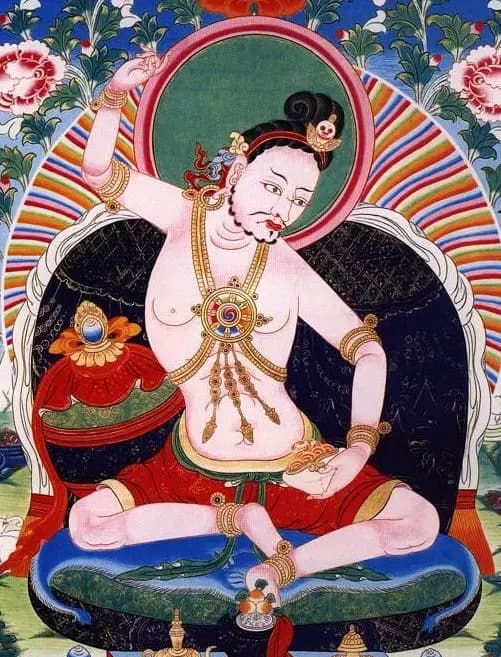
The great compiler of the Dzogchen Pith Instruction Class (Mengakdé), who attended upon the venerable Mañjuśrīmitra for twenty-five years, divided the heart-essence teachings into four cycles, and transmitted the Dharma to Padmasambhava, Vimalamitra, and other masters who carried it into Tibet.
His Name and Past Karmic Bond
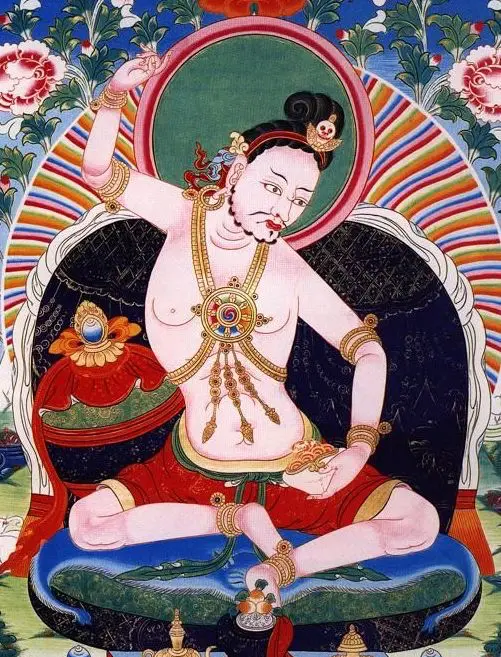
The venerable Shri Singha (Sanskrit Śrī Siṃha, rendered into Tibetan as "Glorious Lion") was the pivotal vidyādhara patriarch who both inherited and transmitted the Dzogchen lineage. In the Indian sequence of Dzogchen masters he is counted as the fifth generation—receiving from above Samantabhadra, Vajrasattva, Garab Dorje, and Mañjuśrīmitra, and giving rise below to the masters who spread the teaching throughout the Land of Snows. He was born at the meeting place of China and Central Asia; tradition generally holds that he came from the city of Shokyam in Khotan. From childhood he was extraordinarily gifted, mastering in his youth the five sciences—grammar, logic, the arts, medicine, and inner science—so that no worldly field of knowledge remained obscure to him. Yet worldly cleverness and eloquence are not the ultimate; since his roots of virtue from past lives ran deep, he was moved by a revelation from a holy one who guided him toward the definitive and supreme Dharma. This was the beginning of his lifelong quest for the path.
Vast Study and Prophecy
In his youth, the venerable one first studied the exoteric and esoteric scriptures under masters such as the ācārya Haribhadra and others, and in less than three years became a great scholar whose fame spread far and wide. Thereafter he dwelt for many years at Mount Wutai, the abode of the bodhisattva Mañjuśrī, studying numerous classes of tantra and penetrating deeply into the ocean of teachings. Yet his aspiration was to realize awareness itself directly, not merely to accumulate learning; therefore he prayed earnestly. The holy bodhisattva Avalokiteśvara appeared to him twice, prophesied, and gave direction, instructing him to journey south to India to seek and receive the unsurpassed heart-essence of Dzogchen. The venerable one acted according to the instruction: forsaking the comforts of China, he went alone to India in search of a master of realization. This episode of prophecy clearly shows that the Dzogchen lineage is not bestowed privately by human power, but is accomplished through the secret blessing and protective care of the buddhas and bodhisattvas, who draw beings in according to their capacity.
Reliance Upon the Master and Realization
After arriving in India, the venerable one encountered, in the cold charnel ground of the Sosaling forest, the great siddha Mañjuśrīmitra—the heart-son of Garab Dorje and the second human patriarch of Dzogchen. There the venerable one relied upon and served him for twenty-five years, fully receiving all the pith instructions of the outer, inner, and secret Dzogchen, directly realizing awareness itself and becoming his Dharma-heir and heart-son. As Mañjuśrīmitra was passing into nirvāṇa, he bestowed his final testament, the Six Meditation Experiences, in the midst of the sky, and pointed out the location of the Dzogchen tantric scriptures he had previously concealed. Following these instructions, the venerable one extracted from within a great boulder near the Vajra Seat of Bodhgayā the root Dzogchen tantras left behind by Mañjuśrīmitra, thus continuing the Dharma lineage without interruption. These twenty-five years of relying upon the master are precisely a model of the Dzogchen lineage's "mind sealed by mind": not a mere transmission of words, but the unbroken continuity of the heart-essence between master and disciple, with the direct introduction to awareness sealed and confirmed.
Classifying the Teachings and Concealing the Treasures
His realization now complete and his compassionate aspiration extending to all, the venerable one undertook the great task of classifying and compiling the teachings. He took the vast teachings of the Dzogchen Pith Instruction Class (Mengakdé, "Class of Esoteric Instructions") and, for the first time, systematically classified them into four cycles—outer, inner, secret, and the unsurpassed innermost secret (the heart-essence, Nyingthik)—establishing the fundamental framework of the Dzogchen lineage and benefiting countless practitioners of later generations. Of these, the outer, inner, and secret three cycles belong to the "elaborate" teachings, which the venerable one concealed as treasure at the Bodhi Tree Temple in China; while the most precious unsurpassed innermost-secret heart-essence he hid within a pillar of the temple "Gate of Glorious Perfection," entrusting it to the dharma-protector Ekajaṭī, the One-Haired Mother, to guard until those with the right karmic connection should reveal it. This classification and concealment of treasures allowed the Dzogchen heart-essence both to be hidden and protected, kept from unworthy vessels, while leaving the key of the lineage for later generations—the most pivotal Dharma-work of the venerable one's entire life. All the later heart-essence treasure cycles of Dzogchen honor this classification as their guiding principle.
Widely Transmitting to Four Sons
From among the venerable one's disciples arose the four great pillars who carried Dzogchen into Tibet. At that time the two venerable ones Vimalamitra and Jñānasūtra received a prophecy at Bodhgayā from Vajrasattva, who appeared and told them that they had been scholars for five hundred lifetimes yet still lacked true realization, and that they should go to the Bodhi Tree Temple in China to seek their root guru, Shri Singha; thus they became the venerable one's disciples. The venerable one transmitted the outer, inner, and secret three cycles to both Vimalamitra and Jñānasūtra; but the unsurpassed innermost-secret heart-essence he transmitted to Jñānasūtra alone, and Jñānasūtra later passed it on to Vimalamitra. In addition, the venerable one also accepted as disciples Padmasambhava and the great Tibetan translator Vairotsana, and entrusted to Vairotsana the teachings of the Mind Class and the Space Class to propagate in the Land of Snows. In this way the three classes of Dzogchen teaching, through the hands of these four great disciples, passed from India through China and into Tibet, laying the foundation of the Dzogchen of the Old-Translation Nyingma school, whose blessing upon the Land of Snows endures without ceasing through countless aeons.
The Rainbow Body and Final Testament
His work of teaching now complete, the venerable one manifested the rainbow-light dharmakāya at the "Gate of Glorious Perfection," rising into the sky within a mass of light and entering parinirvāṇa, displaying the ultimate sign of realization of Dzogchen. At that time his disciple Jñānasūtra wept and fainted in grief; a celestial voice in the sky revived him, and the venerable one extended a hand from within the halo of light, bestowing a casket holding the pith instructions of great treasures. The moment Jñānasūtra touched this casket, he attained realization at once. Such is the origin of the final testament, the Seven Nails. The Seven Nails takes as its essential point the "nailing together" of all opposites—saṃsāra and nirvāṇa, the perceiver and the perceived, mind and outer objects, the two extremes of eternalism and nihilism, phenomena and the nature of phenomena, appearance and emptiness—and through the View alone directly points out awareness itself, without recourse to elaborate practice; it is the very essence of the Dzogchen practice of trekchö (cutting through). Among the testaments of the four vidyādharas, the one left by the venerable one is precisely this Seven Nails, later incorporated into the Vima Nyingtik treasure cycle, and to this day still an unsurpassed pith instruction by which Dzogchen practitioners directly realize the primordial nature.