
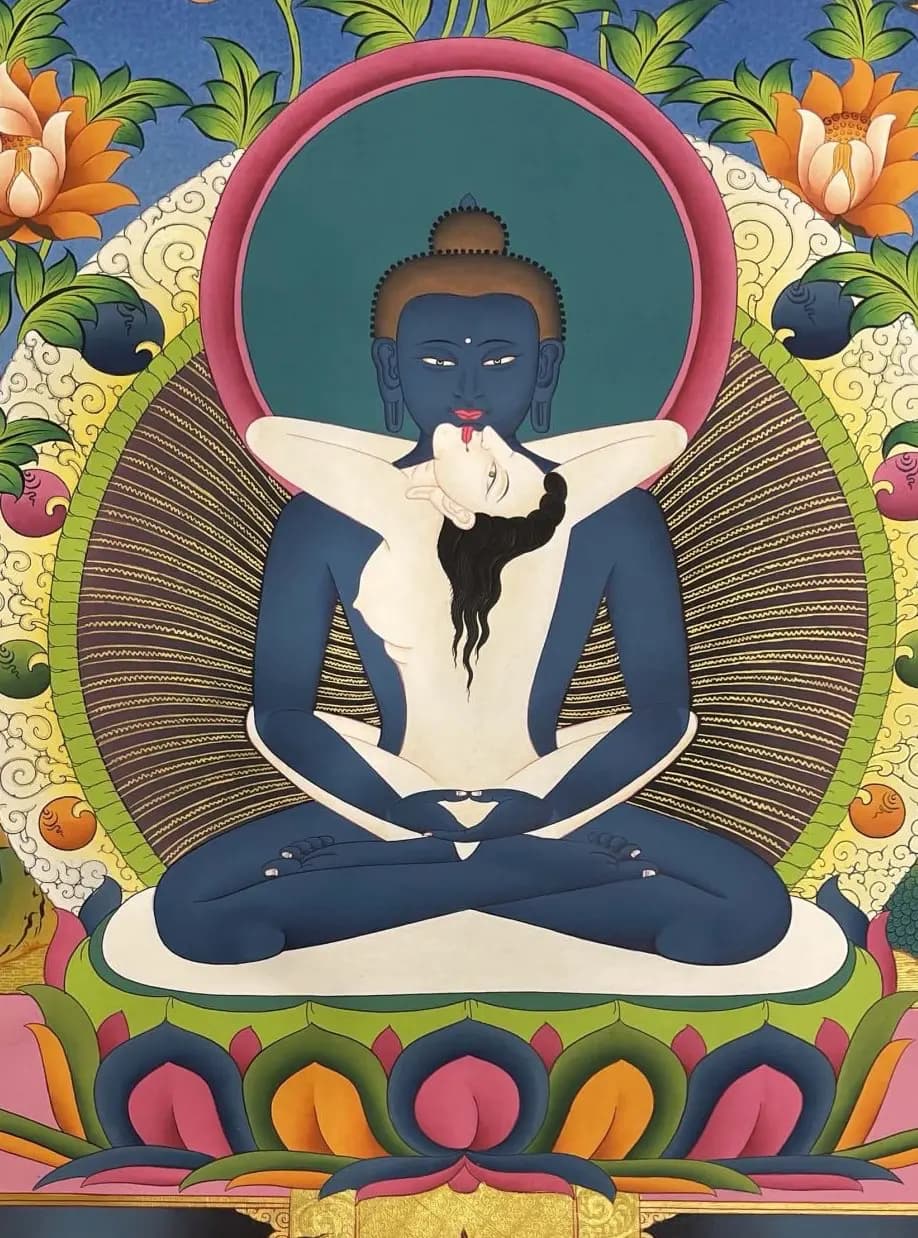
Samantabhadra (Kuntuzangpo)
SAMANTABHADRA · 本初佛
The primordial source of the Dzogchen transmission, the dharmakāya primordial buddha. Through the Mind-Direct Transmission of the Victorious Ones he conveyed self-arisen wisdom directly to the saṃbhogakāya buddhas; he is the root of the three transmissions of Dzogchen. (Note: this is the Nyingma dharmakāya primordial buddha, not the bodhisattva Samantabhadra of the sūtra tradition.)
The Primordial Essence
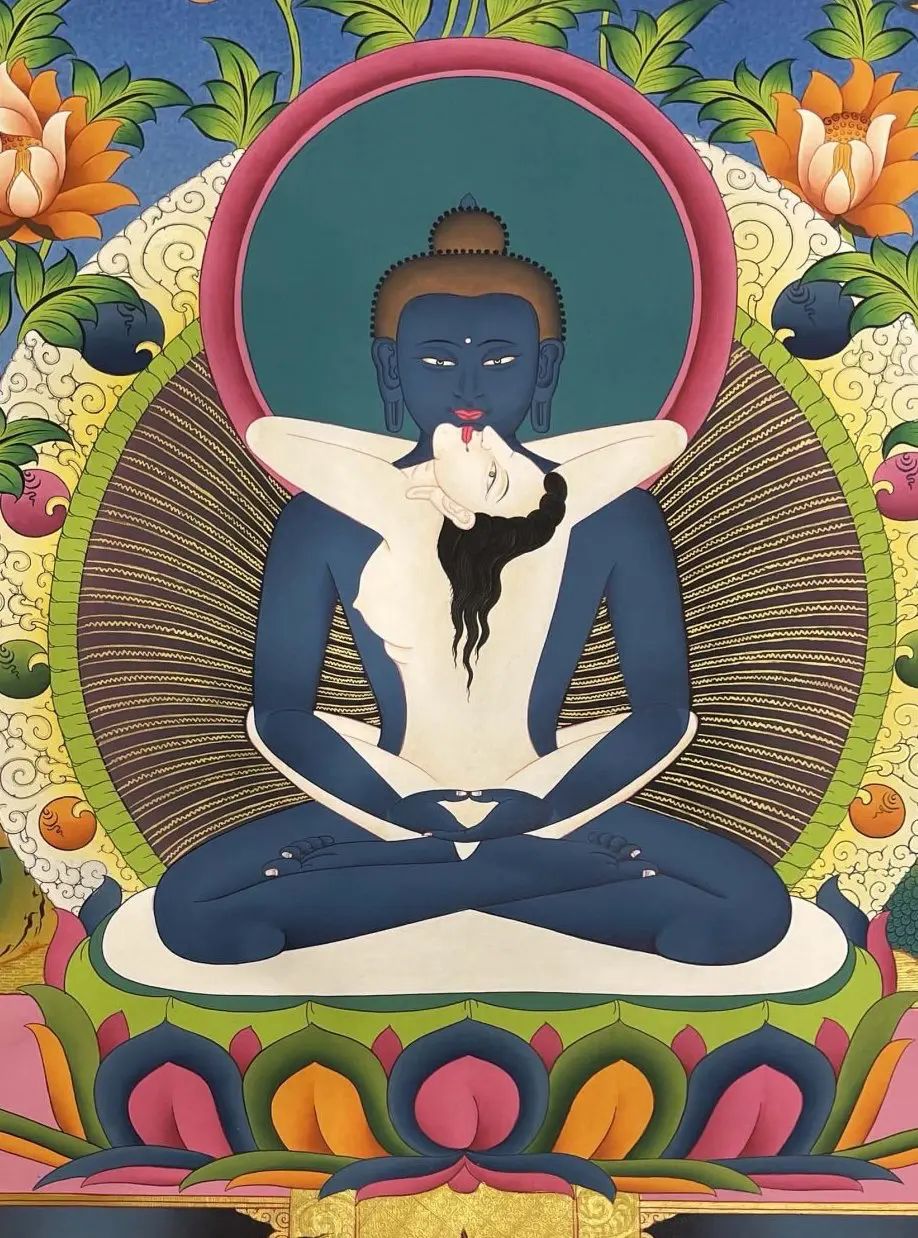
Samantabhadra (Tibetan: Kuntuzangpo, Kun tu bzang po; Sanskrit: Samantabhadra) is not a historical human figure but the supreme emblem of the awakened nature inherent in all sentient beings. The Nyingma school (the Ancient Translations) reveres him as the primordial buddha, representing the dharmakāya — the true reality of mind, the dharmadhātu that is primordially pure, unborn, unconditioned, and undefiled. His name means "ever-perfect and wholly good throughout all time," and so he is also called "All-Good" and "Samantabhadra." He transcends time and space, without beginning or end, and is not reckoned by human chronology; he is the ultimate source from which all the teachings of Dzogchen arise. One distinction must be carefully drawn: this Samantabhadra is the Nyingma dharmakāya primordial buddha, and although he shares a name with the bodhisattva Samantabhadra of the Avataṃsaka Sūtra in the sūtra tradition — who rides a six-tusked white elephant and makes the ten great aspirations — the two differ in essence. Their nature, status, and the scriptures and tantras on which they rest are all distinct, and they must not be confused as one being.
One Ground, Two Paths
The Aspiration Prayer of Samantabhadra (Tibetan: Kunzang Mönlam, Kun bzang smon lam) reveals his fundamental intent: all phenomena of saṃsāra and nirvāṇa arise from a single "ground" (Tibetan: gzhi) — the unborn, unconditioned, ineffable primordial ground. This ground-nature divides into two paths and two fruits according to "recognition" and "non-recognition": one who recognizes the self-aware, self-cognizing nature through rigpa is, in that very moment, a buddha; one who, in ignorance, fails to recognize it wanders as a being of the six realms. What Samantabhadra represents is precisely the "primordial buddha" who, at the very instant the ground arose, recognized his own face, was self-aware and self-cognizing of the nature, and never fell into delusion. He is not a buddha newly accomplished through practice, but the emblem of "being just as it is"; sentient beings, meanwhile, wander through birth and death because of the two forms of non-recognition — coemergent ignorance and conceptual, imputational ignorance. The practice of Dzogchen therefore emphasizes "recognizing" one's innate rigpa, rather than worshipping or supplicating something external.
Iconographic Symbolism
In pure visions and maṇḍalas, Samantabhadra is commonly depicted with a sky-blue body, entirely naked, seated in the vajra posture at the center of space, encircled by spheres of five-colored rainbow light. Blue, vast and unchanging like the sky, signifies the ground from which all appearances arise; the naked form, without crown ornaments or monastic robes, signifies the truth of the dharmakāya — primordially naked, pure, beyond all conceptual fabrication — utterly unlike the resplendent marks and adornments of a saṃbhogakāya buddha. He commonly abides in union (Tibetan: yab-yum) with the consort Samantabhadrī (Tibetan: Kuntuzangmo, Kun tu bzang mo; white in color), signifying the primordial nonduality of method and wisdom, of clarity and emptiness, of awareness and the dharmadhātu. Every symbol points back to the natural mind-nature alone; he is no real creator-god, nor any cosmic substance. In Dzogchen, Samantabhadra is awareness itself, rigpa itself — the personification of the self-nature inherent in every being and never stained by duality.
The Mind-Direct Transmission
Samantabhadra stands first among the three transmissions of Dzogchen — the Mind-Direct Transmission of the Victorious Ones (Tibetan: rgyal ba dgongs brgyud). Mind to mind, without recourse to words, he transmitted self-arisen wisdom directly to the saṃbhogakāya buddhas Vajrasattva and the Five Buddha Families, and on down to the twelve nirmāṇakāya teachers. Thereafter comes the Symbolic Transmission of the Vidyādharas (Tibetan: rig 'dzin brda brgyud — Vajrasattva transmitting through the symbols of awareness to Garab Dorje, the first human forefather, and on through Padmasambhava and the other vidyādharas), and finally the Oral Transmission of Individuals (Tibetan: gang zag snyan brgyud), passed from mouth to ear among human beings. The three transmissions are one continuous stream, and their ultimate root lies in the dharmakāya Samantabhadra. The tantras and pith instructions of all three inner classes of the Nyingma — Mahāyoga, Anuyoga, and Atiyoga (Dzogchen) — likewise take this primordial buddha's Mind-Direct Transmission as their root source.
Scriptural and Tantric Basis
Although it is said that the primordial buddha teaches through the Mind-Direct Transmission and did not personally compose texts, among the Dzogchen tantras there are some that circulate in the world centered upon Samantabhadra. The root tantra of the Mind Class of Dzogchen, The All-Creating King (Tibetan: Kun byed rgyal po), presents Samantabhadra as the "All-Creating King," declaring that all phenomena are the manifestation of his primordial awareness — not that he is a real creator-god, but that all appearances are never apart from rigpa. There is also The Aspiration Prayer of Samantabhadra, drawn from the nineteenth chapter of The Tantra of the Penetrating Wisdom Intent of Samantabhadra (Tibetan: dgongs pa zang thal), the most renowned aspiration prayer of Dzogchen, which in the voice of the primordial buddha proclaims the essential meaning of the one ground and two paths and of awareness self-liberating. Later vidyādhara tertöns revealed it as treasure and spread it among human beings, where it is widely recited. These two — one revealing the root of the view, the other gathering the essence of aspirational power — both take Samantabhadra as their primordial source.
Lineage Position
In the Palyul Nyingma lineage held by this center, Samantabhadra occupies the first position in the lineage chart; he is the ultimate source of all the teachings of Dzogchen and the dharmakāya primordial buddha. Through the Mind-Direct Transmission of the Victorious Ones he directly inspired the saṃbhogakāya Vajrasattva and the Five Buddha Families, and on to Garab Dorje, Śrī Siṃha, and Padmasambhava, down to Longchenpa, Jigme Lingpa, and the successive Palyul forefathers — mind sealed to mind, in an unbroken continuum. To gaze upon Samantabhadra is to gaze upon the primordial purity inherent in one's own mind, never once corrupted; to recall his intent is to spur the practitioner, in this very moment, to recognize his own face, to cut through and leap over directly, and to attain the rainbow-light dharmakāya. Thus the beginning of the lineage is the end of the lineage; the destination of all teachings, in the end, is never apart from this primordial, single-taste dharmakāya essence.