
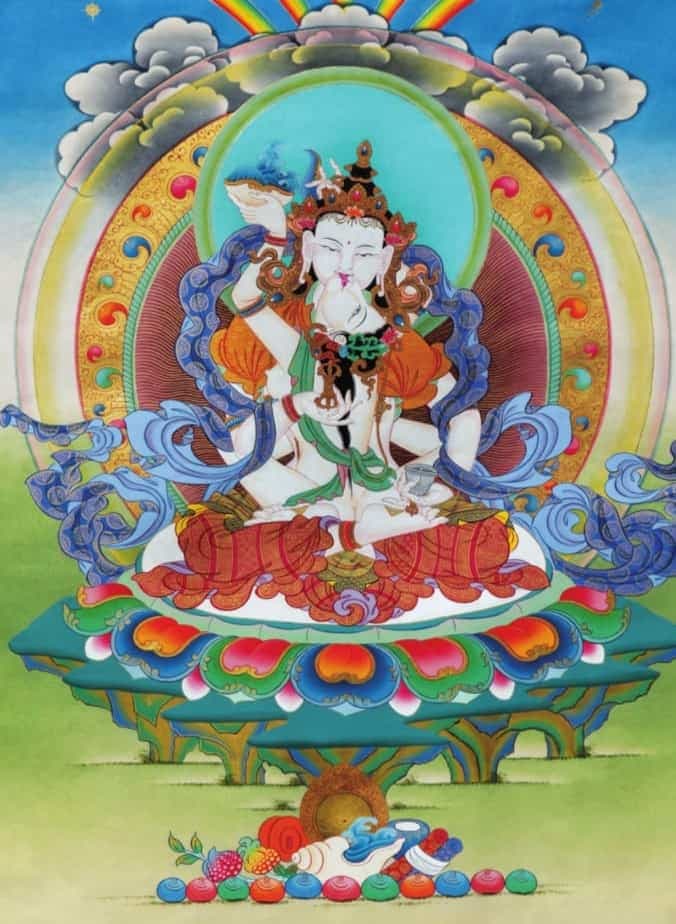
Vajrasattva
VAJRASATTVA · 報身
Lord of all the buddha-families, manifesting in the sambhogakaya dimension. Through the transmission of the vidyadharas by sign, he conveyed the Dzogchen teachings to Garab Dorje, the first human master — the crucial bridge by which the dharmakaya's wisdom-intent descended into the human realm.
The Primordial Nature
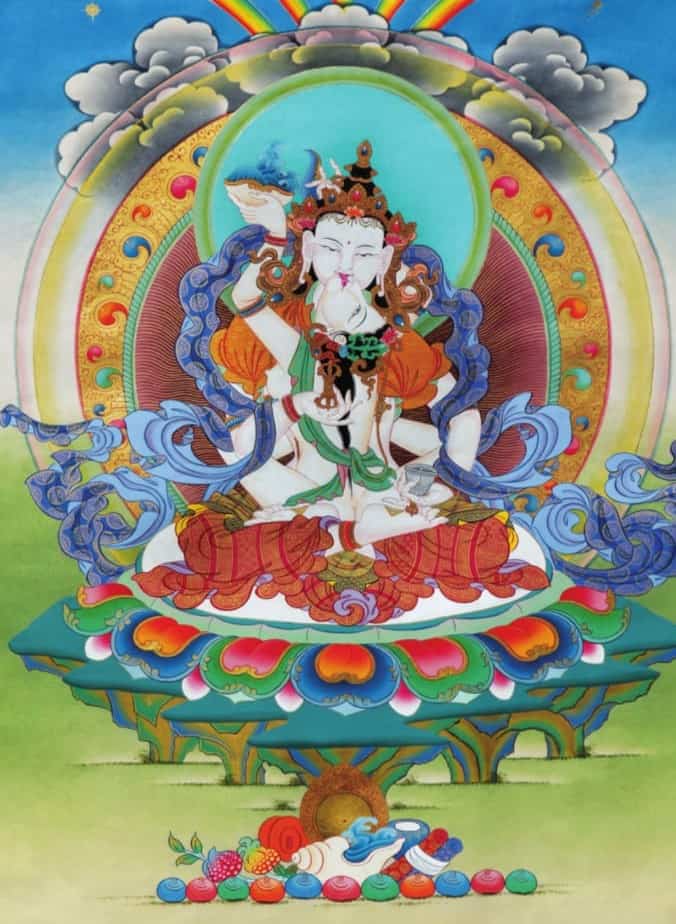
Vajrasattva (Tibetan: Dorje Sempa) is the self-arising reflection of the dharmakaya buddha Samantabhadra, a buddha who manifests in the sambhogakaya dimension. The primordial buddha of the dharmakaya is free of all conceptual elaboration and beyond words and thought; he cannot be seen as form, nor described in name and language. Yet the great compassion of the dharmakaya pervades all, and its self-knowing luminosity never ceases. Thus, within the realm of Akanishtha, the sambhogakaya splendour arises spontaneously — and this is Vajrasattva. He is therefore not some other buddha separate from Samantabhadra, but the continuum of self-luminous awareness, the self-display of emptiness: like a mirror and the image within the mirror, like water and the moon within the water — one in essence, appearing as two. The name "Vajra" expresses the firm, indestructible nature of awareness; "sattva" (being) expresses the courageous, non-regressing valour of great compassion. Together they mean "indestructible courageous mind" — accomplishing the unceasing welfare of beings through indestructible wisdom.
Lord of the Sambhogakaya and Embodiment of the Five Families
Vajrasattva abides in the realm of Akanishtha in the Highest Heaven, lord of all the mandalas of the buddhas, encompassing the five families of tathagatas and the hundred families of noble ones; the qualities of the pure body, speech, and mind of all buddhas are complete and perfect within his single form. The splendour of the buddhas of the five directions arises from, and is gathered within, the sambhogakaya Vajrasattva, so the venerable one is in truth the root support of the five families and the hundred families. His form bears profound and subtle symbolism: his body is white, like a hundred thousand suns illumining a snow mountain, signifying primordial purity, untainted and all-pervading in luminosity; his single face signifies the one ultimate luminous essence (bindu) of the dharmakaya; his two arms signify the inseparable union of wisdom and skilful means; his right hand holds a five-pronged vajra at his heart, signifying skilful means and great compassion, and his left hand holds a bell at his hip, signifying wisdom and emptiness — the single taste of vajra and bell expressing the very meaning of the union of wisdom and skilful means. His crown bears the five buddha families, and his body is adorned with the thirteen ornaments of the sambhogakaya, seated in the cross-legged posture upon a lotus-and-moon throne. When the practitioner contemplates his form and reflects on its meaning, then, entering nature through form, one realizes the primordially pure ground of mind.
The Transmission of the Wisdom-Intent of the Buddhas
Among the three transmissions of Dzogchen, Vajrasattva holds two roles, being the pivot by which the dharmakaya and sambhogakaya descend into the human realm. The first is the "transmission of the wisdom-intent of the buddhas": the dharmakaya buddha Samantabhadra, without relying on speech and without establishing letters, by the wisdom-intent of awareness alone, within the sambhogakaya dimension merges mind to mind and intent to intent with Vajrasattva — transmitting without transmitting, attaining without attaining. This is the supreme transmission, in which buddha-to-buddha realization continues directly through wisdom-intent, transcending subject and object and not falling into words. Vajrasattva abides at the fruition of this transmission of wisdom-intent and further manifests as Vajrapani, compiling into volumes the tantras spoken by the buddhas of the five directions and storing them as treasures in the Highest Heaven, protecting the secret dharma so that it may not be severed, planting the root for the revelation and transmission of treasures by later generations.
The Transmission of the Vidyadharas by Sign
Vajrasattva is also the source of the "transmission of the vidyadharas by sign," which is the crucial bridge by which the dharmakaya's wisdom-intent enters the human realm. The transmission of wisdom-intent can be received only by buddha and buddha; sentient beings cannot directly realize it. Therefore Vajrasattva, by manifesting symbols and conveying pith instructions through signs, transmits the profound meaning of Dzogchen to the noble vidyadharas of the sambhogakaya and nirmanakaya dimensions, causing those who hear to directly perceive and suddenly awaken to their own nature in that very moment. His most essential deed was to bestow the luminosity of the secret Dzogchen dharma upon Garab Dorje, the first human master: in a pure vision he gave Garab Dorje empowerment and prophecy, charging him to write down and compile the six million four hundred thousand verses of the Dzogchen tantras. From this point the Dzogchen teaching descended from the sambhogakaya dimension into the human realm, opening the first deed of the oral and aural lineage among humans. Garab Dorje received this entrustment and transmitted it to Mañjuśrīmitra, who transmitted it to Padmasambhava and Vimalamitra, and so on down the line, until the omniscient dharma-king Longchenpa gathered it into its grand culmination. All the heart-essence Dzogchen teachings of the Nyingma Old Translation school today, traced to their source, arise from this transmission by sign of Vajrasattva.
The Deity of Purifying Obscurations
Vajrasattva is above all the root deity of the methods for purifying misdeeds and obscurations. His vows at the causal stage were vast and profound; he once made a great aspiration: "If any sentient being who has committed the five heinous acts of immediate retribution or has broken the samaya vows hears my name, possesses full faith, and recites the Hundred-Syllable Mantra, that being will surely be purified of all misdeeds and obscurations." By the power of this original vow, the Hundred-Syllable Mantra became the root support of all methods for purifying obscurations, and Vajrasattva likewise stands foremost among the deities of purification. Within the Dzogchen preliminaries, the practice of Vajrasattva is listed as the second of the four extraordinary preliminaries: the practitioner visualizes a white Vajrasattva appearing above the crown of the head, sincerely recites the Hundred-Syllable Mantra, and the nectar of wisdom-water descends from the venerable one's heart, washing away all the misdeeds, obscurations, and stains within one's own continuum. In the end, Vajrasattva dissolves into light and merges into oneself, so that the practitioner and the deity are non-dual and indistinguishable — and this symbolizes the direct realization, here and now, of the primordially pure nature of mind. The earliest scriptural basis of the Hundred-Syllable Mantra can be traced to the tantric cycle of the Compendium of the Reality of All Tathagatas (Sarvatathagata-tattvasamgraha); what it reveals is not merely the dispelling of karma, but in truth a skilful means for leading the practitioner to realize the primordially pure nature of mind.
The Lineage of the Teaching
What Vajrasattva represents is the source of all the tantras of Dzogchen. The Dzogchen tantras, prophesied by him and written down and compiled by Garab Dorje, total six million four hundred thousand verses and form the root treasury of the heart-essence teachings. Among the seventeen tantras of the Mind Section (Semde) of Dzogchen there is also the tantra The Mirror of the Mind of Vajrasattva, which clarifies the essential point of the nature of awareness. The root tantra of Mahayoga, the Guhyagarbha Tantra of the Net of Magical Illusion, takes Vajrasattva as one of its principal deities, expounding the profound meaning of the pure mandala and the generation and completion stages; while the Hundred-Syllable Mantra — common to sutra and tantra and widely transmitted in the world — is the concrete application by which his method of purifying obscurations reaches all kinds of beings. In Nyingma lineages such as the Dudjom Tersar, Vajrasattva is placed second among the masters — receiving from the dharmakaya buddha Samantabhadra above, and opening the way to Garab Dorje, the first human master, below. The heart-essence Dzogchen teachings of this centre — the Longchen Nyingtik and the Namchö (Sky Dharma) — practise Vajrasattva in the four extraordinary preliminaries to purify obscurations, and trace the lineage's root to Vajrasattva to continue its flow. Precisely thus, descending from this sambhogakaya buddha through the heart-seal transmission of the successive vidyadharas, it passed on, generation after generation, down to the root guru of this lineage, Khenpo Nyima Rinpoche — the dharma-lineage clear and manifest, never once severed.